
Table of Contents
The best insulin needle and syringe size, length, and gauge for you depends on your dosage and personal preference. Your doctor may also recommend a specific size based on your body size and the area being pricked.
When you choose the right insulin needle and syringe, the ease of injection is better, which ensures a more effective insulin delivery and, in turn, better sugar control. (1)
Insulin can be delivered through four major ways (2):
Insulin pumps
Insulin pens
Insulin syringes
Insulin inhaler
In this article, we will examine the insulin syringe, which is the most common insulin delivery method, in detail. We will also review needle sizes and lengths to help you pick the best size.
Sizes and lengths of insulin syringes and needles
When using an insulin syringe, you will need a needle, which allows you to self-inject the insulin directly under the skin.
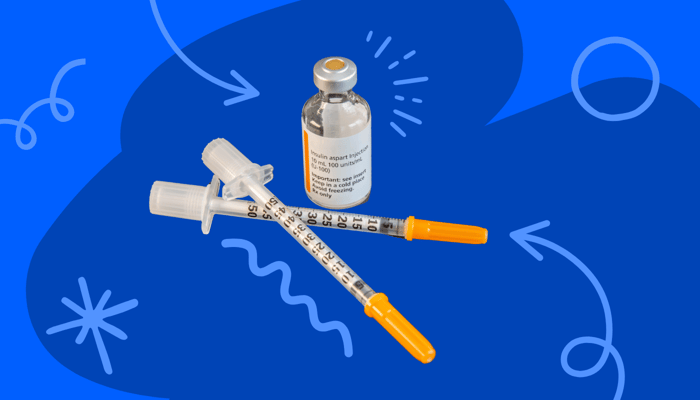
Insulin syringes
There are several types of insulin syringes, often categorized by the volume they can contain and needle size (length and gauge).
In terms of their volume, common insulin syringe types include:
0.3 milliliter (mm) syringe: This is used for doses less than 30 units of insulin. This syringe is suitable for people who need smaller, more precise doses.
0.5 milliliter (mm) syringes: Used for doses between 30 and 50 units of insulin and suitable for people with moderate insulin needs.
1.0 milliliter (mm) syringe: Used for more than 50 units of insulin and suitable for those who require higher doses
The correct size of an insulin syringe is based on the dose of insulin your healthcare provider prescribed. As a rule of thumb, to minimize dosing error, choose the smallest syringe that can contain your largest dose.
For example, if you are prescribed insulin between doses of 30-45 units, then a 0.5ml syringe may be more suitable for you.
Needles
When it comes to needles, two terms are important: length and gauge. A needle gauge determines the needle thickness, and the length determines how far into your skin a needle can penetrate.
Common insulin gauges include 29, 30, and 31. The higher the needle gauge, the thinner the needle.
Short vs long insulin needle
The length of the needle can range from 4 mm to 12.7 mm. The appropriate needle for you is based on your body type and your comfort level.
A short needle is usually less painful and is safer as it does not penetrate the muscle. It is also effective for all body types. (3)
Some people worry that a short needle might not be enough to deliver the full dose of insulin because of its poor penetration into the skin. However, with insulin delivery, the aim is just below the skin, avoiding the muscle just beneath it.
In general, experts recommend needles between 4 mm and 6 mm regardless of body size. If you are using a short needle, inject at a 90-degree angle, without pinching up the skin. (1)
Longer needles can pierce deep into the muscle, which may cause more insulin to be absorbed and could cause hypoglycemia (blood sugar drops dangerously low). (1) If you need long needles, it’s best to pinch your skin or inject at a 45-degree angle to avoid injecting insulin into the muscle. (1)
Thicker vs thinner insulin needle
Overall, thinner needles tend to be more comfortable and less painful. (4) There is also less bruising and tissue damage with thinner needles than with thicker needles.
Thicker needles are more painful, but they may help administer insulin more quickly. (4) A thicker gauge needle may also be helpful when administering large doses, as it may prevent medications from leaking out of your skin.
TRUEplus Insulin Syringes - 29G .5cc 1/2" - BX 100

$ 13.78
$ 16.73
TRUEplus Single-Use Insulin Syringes are backed by a 10 out of 10 rating in laboratory testing*, and are an affordable, quality solution to promote compliance and safety. TRUEplus Diabetes Syringes Features: Silicone-coated, quality needles, with no burrs or surface imperfections… read more
How to Choose the Right Insulin Needle and Syringe
Studies have found that short, thin needles deliver insulin just as effectively as longer, thicker ones. (1) At the end of the day, it boils down to personal preference and comfort levels. That said, here are six steps to choose the right syringe for you.
Choose your syringe based on your prescribed dosage of insulin
Pick the best needle length for you, looking at the pros and cons of longer vs shorter needle length.
Select the needle with the thickness or gauge you desire
Consider your injection site
Take your personal preference into account
Ask your healthcare provider for advice.
Bottom Line
In summary,
For less pain and more comfort: Choose a thinner needle or a higher gauge.
For quicker delivery: Opt for thicker needles or a lower gauge.
To reduce the risk of intramuscular injection and hypoglycemia: Choose shorter needles.
Sources
O'Neal KS, Johnson J, Swar S. Nontraditional Considerations With Insulin Needle Length Selection. Diabetes Spectr. 2015;28(4):264-267. doi:10.2337/diaspect.28.4.264
Centers for Disease Control and Prevention. 4 Ways to Take Insulin.
Yamada S, Yamada Y, Tsukamoto Y, Tabata M, Irie J. A comparison study of patient ratings and safety of 32- and 34-gauge insulin pen needles. Diabetol Int. 2015;7(3):259-265. doi:10.1007/s13340-015-0242-y
American Medical Association. Insulin pens.
FAQs
Can I buy insulin needles over the counter?
Yes, you can buy insulin needles over the counter. While insulin is available only by prescription, you do not need a prescription to get disposable syringes from most pharmacies. You can even get it online if you value convenience.
What is the smallest insulin needle size?
Insulin needle sizes range from 4 mm to 12 mm in length, and 28 to 32 gauge or thickness. The higher the needle gauge, the thinner the needle. So the smallest insulin needle size will be 4 mm in length and 30/31 in gauge.
Can I use a 25g needle for insulin?
While you can use a 25g needle to deliver insulin, it is not recommended as thicker needles are more painful and more likely to scar the muscle tissue. For insulin, thinner needles between 29 and 31 gauge are typically recommended.